Ayutthaya History
Ayutthaya: Rise and Fall of Siam’s Capital
For more than four centuries, Ayutthaya was the working heart of Siam, a river island capital where trade, court ritual, and global diplomacy met. Its ruins still hold the outline of a metropolis that impressed visitors from China to France.
This guide follows Ayutthaya from its fourteenth century founding through its rise as a cosmopolitan power, its destruction in 1767, and the legacy that endures in its stones.
Before you visit
Reading Ayutthaya story first will help you notice details like royal chedis, prang towers, and river aligned temple layouts when you explore the ruins.
Ayutthaya was founded on strategic rivers and grew into a metropolis that shaped Siam for more than four centuries. Its ruins map a city that was once a global crossroads, a ceremonial court, and a fortress that held off rivals until the Burmese siege of 1767 ended its era.
Key Historic Events and Facts
1350
Ayutthaya founded by King U Thong (Ramathibodi I) on an island at the confluence of the Chao Phraya, Pa Sak, and Lopburi rivers.
1370s to 1430s
Rapid consolidation as Sukhothai is absorbed and Ayutthaya captures Angkor in 1431, signaling Khmer decline.
1511 to 1516
First European contact. Portuguese envoy Duarte Fernandes arrives and a treaty permits trade and settlement.
1569
Ayutthaya falls to Burma. King Maha Thammaracha rules as a vassal and independence is lost for fifteen years.
1593
Prince Naresuan restores independence. Tradition remembers his duel on war elephants.
1656 to 1688
Reign of King Narai. Embassies arrive from France and Persia and population reaches the hundreds of thousands.
1688
King Phetracha takes the throne, curtailing French influence while Asian trade remains strong.
1765 to 1767
Major Burmese invasion and siege ends with the destruction of Ayutthaya in April 1767.
1767 to 1782
King Taksin reunifies Siam from Thonburi, later followed by the move to Bangkok under King Rama I.
1991
Historic City of Ayutthaya inscribed as a UNESCO World Heritage Site.
Founding and Rise of Ayutthaya
In 1350, U Thong (Ramathibodi I) established a new capital on a naturally moated island that was defensible, fertile, and perfectly placed on maritime routes. Waterways brought rice, timber, and ceramics from inland valleys and carried ships up from the Gulf of Siam.
Ties of marriage and alliance linked Lopburi and Suphanburi to the new court. Ayutthaya soon eclipsed Sukhothai, formally absorbing it in 1438. Tribute missions to Ming China and a flourishing entrepot economy financed armies and monumental building.
Why the location mattered: Three rivers created natural defenses and direct trade access. Ayutthaya was built to be both a fortress and a port.
Within a century of its founding, a fortified town became a regional power whose influence spread through diplomacy, vassal networks, and control of rice rich plains.
Splendors of Court and Culture
Ayutthaya’s rulers drew on Theravada ideals of the dhammarāja alongside Khmer-influenced models of sacral kingship (devarāja, cakravartin). Court ceremony, law, and patronage projected authority.
In the mid-15th century, King Borommatrailokanat (Trailok) reformed administration: the Chatusadom (four-pillar) system, civil and military prime ministers, and a codified hierarchy tied to sakdina ranks. This centralized rule while accommodating local power in a mandala network of vassal states.
Religion shaped daily life. Kings built and endowed monasteries, and Ayutthaya became a Theravada hub with lively exchanges with Sri Lanka. Brahman priests oversaw royal rites like the Ploughing Ceremony, creating a distinctive blend of Buddhist devotion and Hindu court ritual.
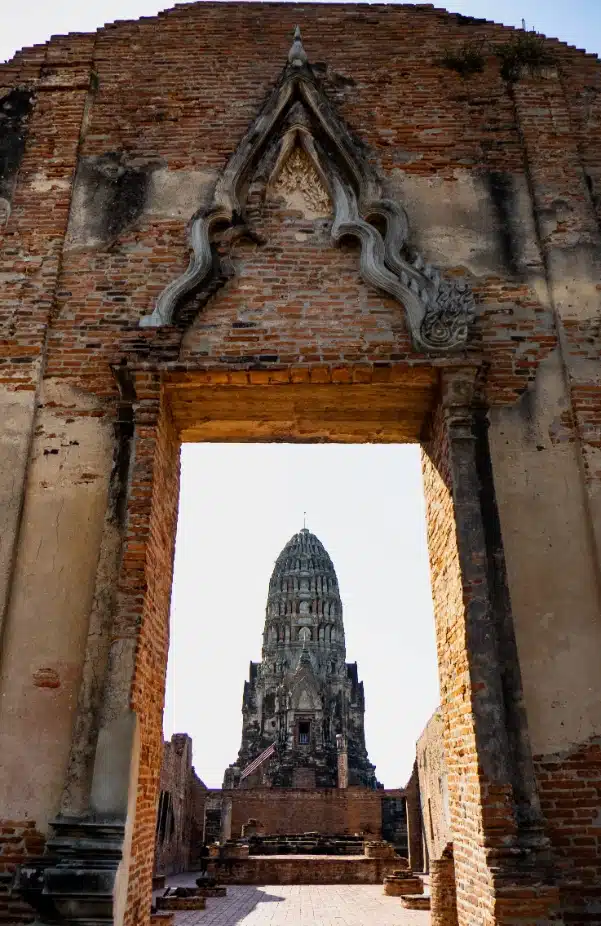
Art and architecture flourished: soaring prang tower-shrines and bell-shaped chedis (stupas) rose on high platforms above flood-plains; palace compounds carried multi-tiered roofs and gilded finials. Literature, masked dance-drama (khon), sculpture, and lacquerwork reached refined forms; murals sometimes pictured foreign merchants alongside jātaka scenes, evidence of a cosmopolitan city at ease with the wider world.
Capital of Siam: Triumphs and Turmoil
From 1350 to 1767, Ayutthaya anchored a unified Siam through war and peace. Forts like Pom Phet guarded the island; campaigns against Angkor ended Khmer dominance by 1431; Trailok’s reforms consolidated the north.
The 16th century brought Burmese rivalry. In 1548, chronicles memorialize Queen Suriyothai’s sacrifice. Ayutthaya fell in 1569 to Bayinnaung’s Toungoo forces, entering a vassal phase under Maha Thammaracha. Resistance soon revived: by the 1590s, King Naresuan restored independence and prestige.
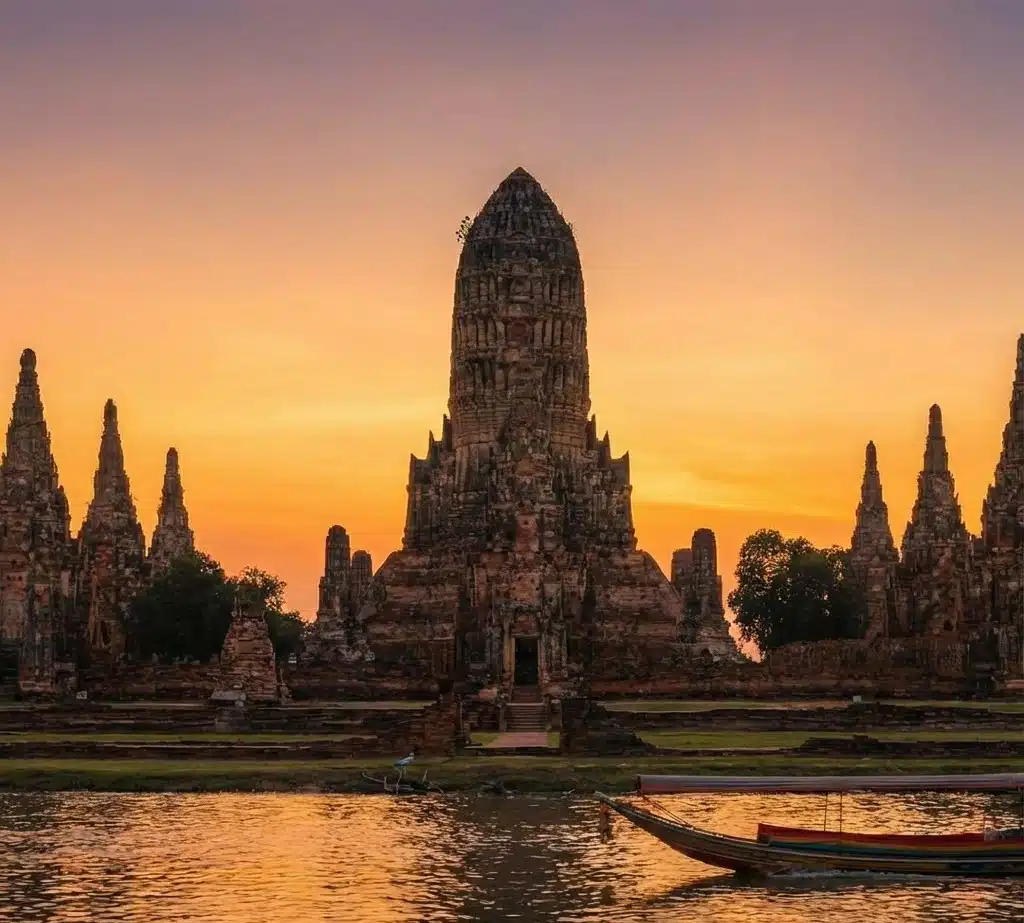
The 17th century was broadly stable. Prasat Thong beautified the capital: Wat Chaiwatthanaram (วัดไชยวัฒนาราม, Wat Chaiwatthanaram) on the river remains a signature silhouette, while King Narai opened the court to embassies from France, Persia, China, and India. After Narai’s final illness, the 1688 realignment under Phetracha reduced European roles but did not halt prosperity.
In the 18th century, religious patronage continued (notably under Borommakot), yet succession strife and weaker leadership thinned the city’s defenses as a resurgent Burmese kingdom gathered strength.
A Cosmopolitan Crossroads
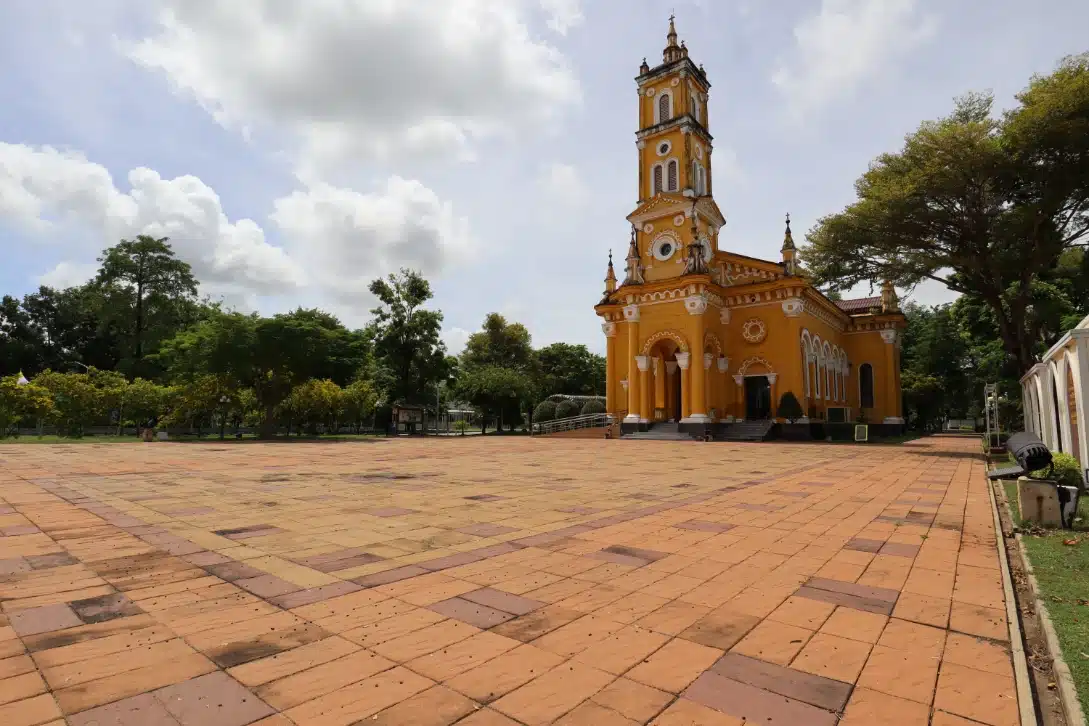
Ayutthaya’s riverfront hosted quarters for Chinese, Persians, Indians, Japanese, Malays, and Europeans. The Portuguese arrived first (treaty by 1516), bringing gunnery expertise and new foods; the Dutch VOC built warehouses near today’s Baan Hollanda; the English came and went; and relations with France crescendoed in the 1680s before the 1688 turn inward.
Links across Asia were equally dense. Ban Yipun, the Japanese settlement under Yamada Nagamasa, supplied elite guards. Persian merchants, especially Sheikh Ahmad, rose to high office in port administration. Markets brimmed with Chinese silks, Indian cottons, Persian carpets, Japanese lacquerware, and European clocks alongside Siamese goods.
Cosmopolitan but sovereign: The court welcomed trade and knowledge while insisting on Siamese independence in diplomacy.
Fall of Ayutthaya and Aftermath
Konbaung Burma’s rise brought renewed war. After a near miss in 1759–1760, converging Burmese armies besieged the capital in 1765–1767. Starvation, disease, and artillery wore down defenses; in April 1767 the walls were breached. Fires consumed palaces and archives; artisans and courtiers were taken captive; Buddha images were defaced or carried off.
Within months, Phraya Taksin regrouped Siamese forces at Thonburi, driving out remaining Burmese detachments. In 1782, King Rama I founded a new capital at Bangkok. Ayutthaya’s bricks and many memories went downriver to build a new court.
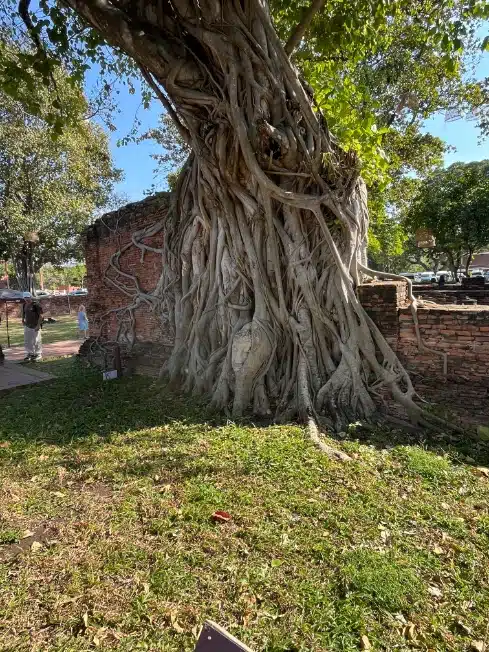
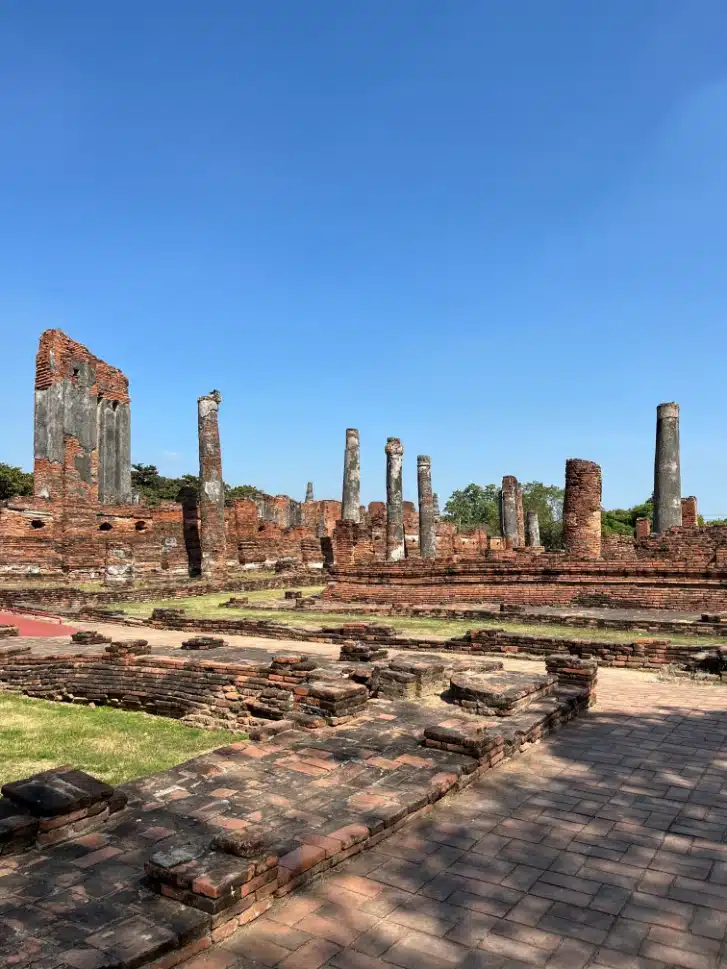
The ruins slept under vines until modern conservation. From early 20th-century efforts by the Fine Arts Department to the 1991 UNESCO inscription, the Historic City has become a vast archaeological park where Wat Phra Si Sanphet (วัดพระศรีสรรเพชญ์, Wat Phra Si Sanphet), Wat Mahathat (วัดมหาธาตุ, Wat Mahathat), and Wat Yai Chai Mongkhon (วัดใหญ่ชัยมงคล, Wat Yai Chai Mongkhon) trace a legible map of the old capital.
Legacy
Ayutthaya’s institutions shaped later Siam. Court ceremony, administrative practice, and legal traditions carried into the Rattanakosin era. Cuisine absorbed ingredients introduced through its cosmopolitan kitchens, and regional chronicles preserve the city’s influence.
For visitors today, the site rewards slow looking. Axial plans, elevated platforms, and the choreography of river and road reveal how the capital once worked. The ruins are not only remnants. They are records of a political imagination that spanned monasteries and maritime routes, and a reminder that even the mightiest capitals can become monuments for later generations to read.